

It is a component of more than 140 enzymes involved in metabolism and energy production.
Iron contributes to the synthesis of chlorophyll, activates cytochrome enzymes responsible for cellular respiration,
and plays a role in nitrate reduction and nitrogen fixation in leguminous plants.
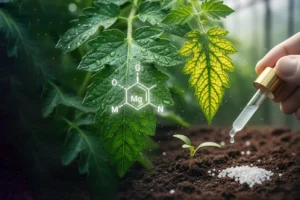
However, iron is immobile within plant tissues, so its deficiency first appears in young leaves as interveinal chlorosis.
In calcareous or alkaline soils, iron transforms into insoluble forms, preventing plant uptake.
Here comes the role of iron chelates, which keep iron soluble and available for plant absorption.
⚙️ Mechanism of Action of Fe-EDTA in Plants
The compound Fe-EDTA (iron chelated by Ethylenediaminetetraacetic acid) is one of the most widely used iron sources in agriculture,
due to its ability to maintain iron stability under moderately acidic conditions.
EDTA binds ferric ions (Fe³⁺) into a chemical complex that prevents them from reacting with phosphates or carbonates,
keeping them soluble in the soil solution for longer periods.
- Facilitates iron uptake through root hairs.
- Prevents iron precipitation as insoluble oxides or phosphates.
- Maintains iron availability even with high calcium or magnesium levels.
However, when the pH exceeds 6.5, the complex gradually decomposes,
and the effectiveness of Fe-EDTA decreases significantly compared to stronger chelates such as DTPA or EDDHA.
Effect of Fe-EDTA Deficiency and Excess
Severe iron deficiency reduces photosynthesis and energy (ATP) production,
causing stunted growth and yellowing of young leaves.
On the other hand, excessive use of Fe-EDTA may lead to iron accumulation in tissues,
which can inhibit the uptake of other micronutrients such as zinc and manganese.
Hence, precise dosing is necessary depending on the plant type and growth medium.
Findings of the Recent Study (HortScience, 2025)
A recent study published in HortScience (2025) compared the effectiveness of three iron chelates
(Fe-EDTA, Fe-DTPA, and Fe-EDDHA) in preventing iron chlorosis in sensitive plant species grown in alkaline soilless media.
| Chelate Type | Optimal Efficiency | Suitable pH Range | Recommended Concentration |
|---|---|---|---|
| Fe-EDTA | Effective only in acidic environments | ≤ 6.5 | 50–80 µM (3–4 mg/L Fe) |
| Fe-DTPA | Effective across a wider range | ≤ 7.3 | 80–100 µM |
| Fe-EDDHA | Most stable in alkaline media | ≤ 9.0 | 100–120 µM |
The study found that plants treated with Fe-EDTA at pH = 6.0
had a 28% increase in chlorophyll content compared to the untreated group,
while the efficiency dropped below 10% at pH = 7.5.
Practical Recommendations for Farmers
- Choose the chelate type based on pH:
Use Fe-EDTA only when the medium or irrigation water is acidic (pH ≤ 6.5).
For calcareous soils, Fe-DTPA or Fe-EDDHA is recommended. - Application frequency:
The study showed that 2–3 fertigation cycles per week were more effective than a single application. - Foliar feeding:
Optimal concentration ranges between 2–3 g Fe-EDTA per 10 L of water. - Monitoring:
Leaf iron content should be analyzed biweekly to adjust dosage accordingly.
Future of Iron Chelates in Smart Agriculture
With the rise of Precision Agriculture,
research now focuses on integrating iron chelates with smart sensors and automated irrigation systems.
Future innovations aim to develop slow-release intelligent chelates
that maintain iron availability for longer periods and minimize nutrient losses.
There is also increasing interest in using eco-friendly bio-chelates
derived from natural organic acids to enhance sustainable iron uptake.
Conclusion
Fe-EDTA remains one of the most effective iron sources in acidic and neutral environments,
though its efficiency declines sharply in alkaline conditions.
Choosing the appropriate chelate (EDTA, DTPA, or EDDHA) based on soil conditions
is essential for achieving optimal plant nutrition and productivity.
Implementing these findings in precision fertilization programs helps farmers reduce costs and enhance growth efficiency.
Academic Reference
Sánchez-Pérez, M., et al. (2025).
Fertigation with Fe-EDTA, Fe-DTPA, and Fe-EDDHA Chelates to Prevent Iron Chlorosis of Sensitive Species in High-pH Soilless Media.
HortScience, 60(3), 254–263.
[Read the full paper]
Frequently Asked Questions (FAQ)
Can Fe-EDTA be used in alkaline soils?
In such cases, Fe-DTPA or Fe-EDDHA should be used.
What is the safe dose of Fe-EDTA for sensitive plants?
or 50–80 µM when applied via irrigation systems.
Can Fe-EDTA be mixed with other fertilizers?
but direct mixing with concentrated phosphates should be avoided to prevent iron precipitation.