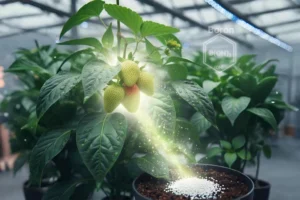


Magnesium (Mg²⁺) is an essential macronutrient for plant growth and development.
Although it is often overlooked compared to nitrogen or potassium, magnesium plays a central role in photosynthesis, energy transfer, and carbohydrate transport, making it indispensable for achieving both high yield and superior fruit quality in horticultural crops.
Physiological Importance of Magnesium
Magnesium is the central atom in the chlorophyll molecule, meaning that each chlorophyll molecule contains one Mg²⁺ ion. Without it, plants cannot capture solar energy efficiently.
Key physiological roles include:
-
Activation of more than 300 enzymes involved in energy metabolism.
-
Facilitating carbohydrate transport from leaves to fruits and roots.
-
Enhancing phosphorus uptake within plant tissues.
📊 Research showed that Mg deficiency can reduce photosynthetic efficiency by 30–50% in tomato and pepper plants compared to balanced nutrient conditions (Farhat et al., 2023).
Magnesium Deficiency Symptoms
Because magnesium is mobile in plants, deficiency symptoms appear first on older leaves.
Common visual signs include:
-
Interveinal chlorosis (yellowing between veins)
-
Leaf edge necrosis in severe cases
-
Reduced fruit firmness and sweetness
In tomato (Solanum lycopersicum), Mg deficiency lowered total soluble solids (TSS) from 6.4% to 4.8%, indicating a decline in fruit quality (Plants, 2023).
Optimal Magnesium Concentrations
Magnesium requirements vary across species and growth stages.
According to recent findings, the following ranges are considered optimal:
| Crop Type | Leaf Mg concentration (mg·g⁻¹ DW) | Nutrient solution Mg (mmol·L⁻¹) |
|---|---|---|
| Leafy vegetables (lettuce, spinach) | 3.0 – 6.0 | 1.0 – 2.0 |
| Fruit crops (tomato, strawberry) | 2.5 – 4.0 | 1.5 – 2.5 |
| Tuber crops (potato) | 2.0 – 3.5 | 1.0 – 2.0 |
In hydroponic tomato systems, increasing Mg concentration to 2 mmol·L⁻¹ enhanced root biomass by 25% compared with Mg-deficient treatments (PMC10628537).
Interactions Between Magnesium and Other Nutrients
Magnesium uptake is competitively inhibited by other cations, mainly potassium (K⁺) and calcium (Ca²⁺).
Excessive K or Ca levels in the substrate can reduce Mg availability and trigger deficiency even when total Mg content is adequate.
In cucumber experiments, doubling K concentration in the nutrient solution decreased Mg uptake by 35%.
Magnesium and Fruit Quality
Adequate magnesium supply significantly improves fruit nutritional and physical quality through:
-
Increasing vitamin C content by up to 20–25%.
-
Enhancing firmness in peppers and strawberries.
-
Improving sugar translocation, leading to sweeter fruits.
In bell pepper (Capsicum annuum), foliar application of MgSO₄ at 2 mmol·L⁻¹ increased fruit yield by 18% compared to untreated control plants (Farhat et al., 2023).
Management Practices for Magnesium Fertilization
Magnesium can be supplied using several approaches:
-
Soil fertilization with magnesium sulfate (Epsom salt).
-
Foliar spraying with 1–2% MgSO₄ solution.
-
Nutrient solution supplementation (1.5–2.0 mmol·L⁻¹) in hydroponics.
Consistent Mg foliar feeding was shown to boost total yield by 10–30% in Mg-sensitive crops like tomato and pepper.
Future Perspectives
The review highlights several directions for upcoming research:
-
Breeding Mg-efficient cultivars with superior uptake mechanisms.
-
Investigating molecular cross-talk between magnesium and macronutrients.
-
Utilizing remote sensing technologies for early Mg deficiency detection through spectral reflectance analysis.
Future horticultural systems should integrate Mg nutrition into precision fertilization strategies to ensure both productivity and sustainability.
Reference
Farhat, N., et al. (2023). Magnesium in Horticultural Crops: Current Status, Physiological Roles, and Future Perspectives. Plants, 12(21), 3794.
https://pmc.ncbi.nlm.nih.gov/articles/PMC10628537