
Phosphorus is one of the essential macronutrients for plant growth, as it is involved in the composition of energy molecules (ATP), nucleic acids, and phospholipids, directly influencing cell division and photosynthesis.
Although soil contains large amounts of total phosphorus, less than 0.1% of it is in a form available to the plant (Pi – inorganic phosphate), due to its strong binding with calcium, iron, or aluminum.
A study published in the journal Frontiers in Plant Science in 2021, titled:
“Phosphate-Dependent Regulation of Growth and Stresses Management in Plants”
indicates that the balance of phosphorus in the soil and the plant represents a key factor for healthy growth and tolerance to environmental stresses.
Importance of Phosphorus and the Challenge of its Availability
- The optimal concentration of available phosphorus in the soil ranges between 10 and 15 mg P/kg soil, which is the limit that allows the plant to complete its life cycle with normal growth.
- In conventional agriculture, phosphorus is typically added at a rate of 100 to 120 kg P₂O₅ per hectare annually to compensate for losses and ensure adequate supply.
- However, studies show that more than 70% of the phosphorus added in fertilizers converts into unavailable forms after a short period, necessitating improved nutrient management rather than just increasing the quantity.
Effect of Phosphorus Deficiency on Growth and Photosynthesis
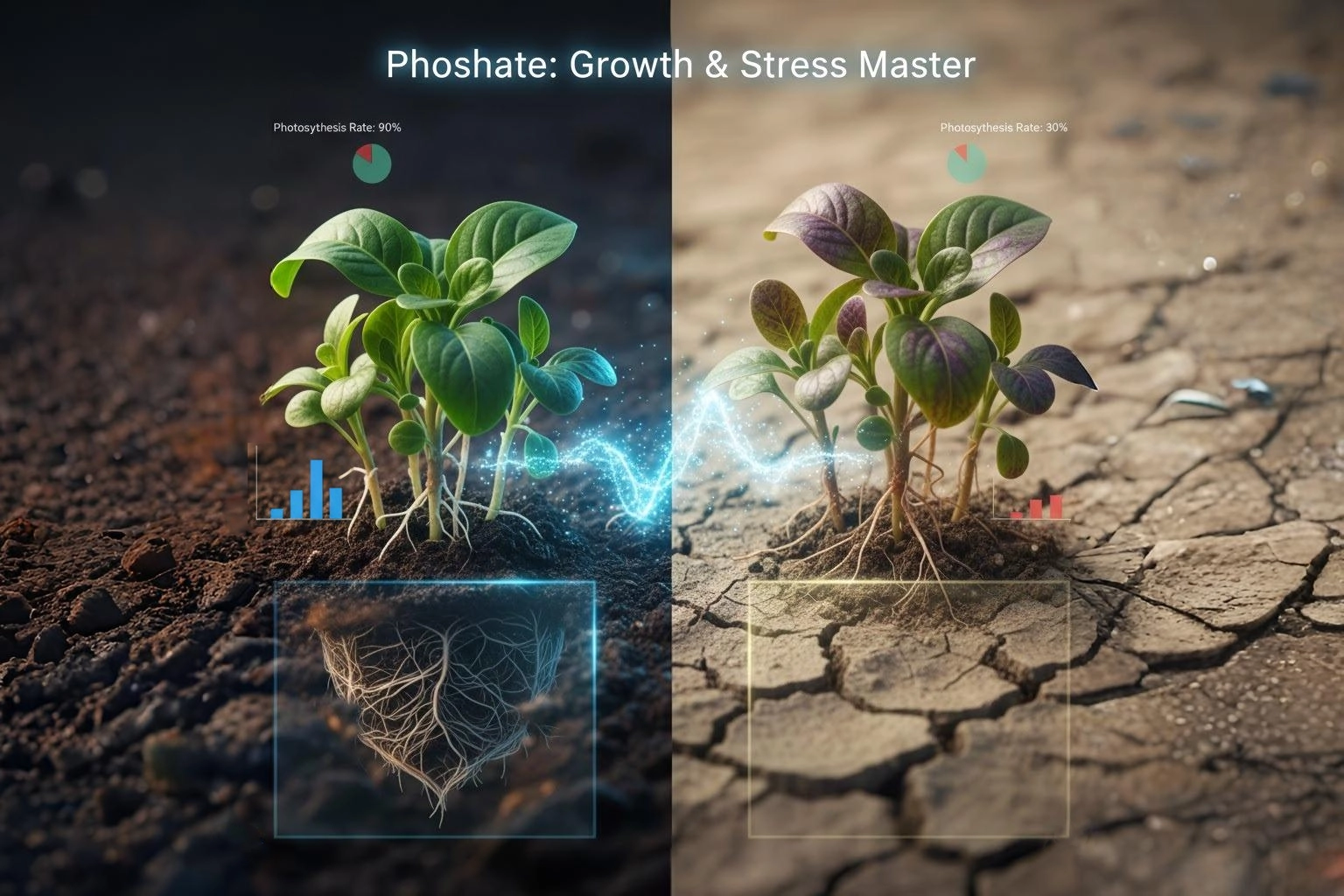
When the concentration of Pi decreases, the plant’s efficiency in energy production and transfer drops, and symptoms begin to appear as slow growth and yellowing of old leaves. The research paper’s results showed that:
- The rate of photosynthesis decreased by 30.1% in soybean, 43.9% in wheat, and 19.9% in corn under phosphorus deficiency compared to the optimal condition.
- Chlorophyll content decreased by about 46% in soybean and 31% in oat.
- The dry mass of leaves and roots decreased by an average of 40–135% depending on the plant species.
- In contrast, phosphorus uptake increased by 56–70% in some crops when it was available.
Role of Phosphorus in Environmental Stress Resistance
Phosphorus acts as an internal regulator for the plant’s response to drought, salinity, heavy metals, and heat.
1. Drought
- Under drought, supplying soybean with sufficient phosphorus led to a 96.8% increase in leaf phosphorus concentration compared to deficient plants.
- Antioxidant enzyme activity also increased, reducing the accumulation of free radicals (ROS) and delaying wilting symptoms.
2. Salinity
- Feeding the plant with P helped maintain photosynthetic activity and reduce sodium uptake, though it did not completely eliminate the effect of salinity.
- In corn, for example, P deficiency led to higher rates of $\text{Na}^{+}$ uptake in leaves than in well-nourished plants.
3. Heavy Metals
- Wheat showed a reduction in the accumulation of Cadmium (Cd) and Lead (Pb) by about 55% when adequate phosphorus was available.
- Corn, on the other hand, saw reductions of 14% for Cadmium, 35% for Lead, and 37% for Zinc.
- Phosphorus also led to the activation of protective enzymes such as Catalase (CAT) and Ascorbate Peroxidase (APX), reducing cellular damage resulting from metal toxicity.
4. Acidity and Poor Soils
- In acidic soil (pH less than 5.5), phosphorus converts into insoluble compounds with aluminum and iron, but adding Pi at moderate concentrations (10–15 mg/kg soil) improved root biomass by up to 25%.
- Root microbes (such as Bacillus and Pseudomonas) also contributed to increasing the solubility of complex phosphorus and improving its uptake.
Genetic Pathways Associated with Phosphorus Regulation
The regulation of Pi uptake and utilization relies on a network of genes, the most important of which are:
- PHT1 family: Phosphate transporters responsible for Pi uptake from the soil.
- PHO1: Regulates Pi translocation from the root to the shoot.
- SPX: Controls phosphorus homeostasis within cells.
- GmPHR25 and GmPAP12 in soybean: Associated with stimulating uptake and increasing the secretion of acid phosphatase enzymes to release Pi.
These genes are automatically activated when the Pi level is low, and they coordinate with stress hormones like Abscisic acid (ABA) and Ethylene to modify growth.
Agricultural Practices to Improve Phosphorus Efficiency
The study suggests several practical solutions that farmers can adopt:
- Use of smart phosphorus fertilizers (slow-release or nano-fertilizers) to minimize losses and improve gradual availability.
- Application of phosphorus-solubilizing microbes to the soil, to increase the biological dissolution of unavailable forms.
- Foliar fertilization with phosphate at a concentration of 0.5–1% to stimulate growth during sensitive stages without overloading the soil.
- Selection of plant varieties with high Pi uptake efficiency through breeding programs based on genes regulating transport and storage.
- Utilizing “Legacy P” stored in the soil through better management of water, tillage, and crop rotation.
Conclusion
Phosphorus is not merely a plant nutrient; it is a central factor for adaptation and sustainability.
From improving growth and production to enhancing resistance to drought and salinity, this element demonstrates an integrated role in supporting smart and sustainable agriculture.
Since its use efficiency does not exceed 20–30% of the amounts added annually in many agricultural systems, improving phosphorus management is a strategic priority for achieving high and sustainable production in the future.
Reference
- Bechtaoui, N., Rabiu, M. K., Raklami, A., Oufdou, K., Hafidi, M., & Jemo, M. (2021). Phosphate-Dependent Regulation of Growth and Stresses Management in Plants. Frontiers in Plant Science, 12, 679916. https://doi.org/10.3389/fpls.2021.679916