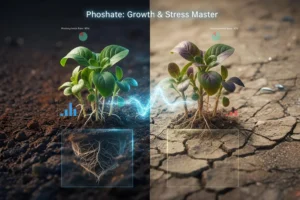


With global climate change and increasing periods of drought, enhancing plant resistance to water deficit has become essential for improving agricultural productivity. One promising approach to support this resistance is the use of biostimulants, including seaweed extracts such as Ascophyllum nodosum and one of its major components: Alginic Acid (AA).
What is Alginic Acid?
Alginic acid is a natural polysaccharide extracted from brown algae (such as Ascophyllum nodosum). It consists of guluronate and mannuronate units. It possesses unique properties such as gel formation, water retention, and biocompatibility, making it useful in agricultural applications for enhancing the plant’s ability to retain water and activating its immune and enzymatic defenses.
Study Summary: Experimental Design
The plant species used was Brassica campestris (variety BARI Sarisha-17).
Drought stress was initiated at 15 days after sowing (15 DAS) by reducing soil moisture to 25% of field capacity.
After plant acclimation, foliar spraying was applied using:
-
Ascophyllum nodosum extract (ANE) at 0.02%
-
Alginic Acid (AA) at 0.02%
Data were collected at 35 days after sowing (35 DAS) on several morphophysiological and biochemical indicators.
Key Results of Alginic Acid (AA)
The study shows that AA application has strong positive effects under drought stress compared to untreated plants — and in some cases, equal to or better than the full extract (ANE).
1. Growth and Biomass
Drought (25% soil moisture) reduced growth, biomass accumulation, and plant water balance.
Spraying AA (0.02%) improved plant growth and biomass compared with drought-stressed plants without treatment.
2. Photosynthetic Pigments (Chlorophyll)
Drought reduced chlorophyll content, negatively affecting photosynthesis.
With AA treatment, chlorophyll content increased, indicating partial protection of the photosynthetic system.
3. Oxidative Stress
Under drought, oxidative damage increased, shown by:
-
Higher lipid peroxidation
-
Elevated H₂O₂ levels
-
Increased electrolyte leakage
-
Increased proline accumulation (an osmolyte)
With AA foliar spray:
-
Lipid peroxidation decreased
-
H₂O₂ levels dropped
-
Electrolyte leakage decreased
Although proline still increased (a typical drought response), AA reduced the oxidative damage associated with this increase.
4. Antioxidant Defense System
AA enhanced the activities of antioxidant defense enzymes, including enzymes of the ascorbate–glutathione (AsA–GSH) cycle.
It also improved the redox balance of ascorbate and glutathione pools, indicating greater ability to regenerate reduced forms — essential for ROS detoxification.
5. Glyoxalase Pathway
The glyoxalase system includes enzymes (Glyoxalase I and II) that detoxify harmful compounds such as methylglyoxal, which accumulates during drought.
AA application increased enzyme activity, reducing toxic compound buildup and improving tolerance to oxidative stress.
6. Water Balance and Cellular Stability
AA improved the plant’s water status, such as relative water content (RWC), compared with untreated drought-stressed plants.
This suggests that AA helps maintain water retention — a critical factor under limited water availability.
Effectiveness Compared to ANE
In many parameters, 0.02% Alginic Acid performed as well as or slightly better than the full Ascophyllum nodosum extract (ANE).
This indicates that AA — a single component of the full extract — can reproduce many of the extract’s benefits, potentially simplifying agricultural use and reducing cost.
Why Is Alginic Acid Effective Against Drought?
AA’s effectiveness can be explained by several interconnected mechanisms:
-
Water retention:
Its gel-forming ability helps retain water around cells or leaf surfaces, reducing water loss. -
Enhanced antioxidant defense:
By stimulating the AsA–GSH pathway, AA reduces ROS-related damage. -
Detoxification of harmful compounds:
Through activation of the glyoxalase system, AA reduces methylglyoxal accumulation under stress. -
Improved cellular balance:
AA supports membrane stability and reduces electrolyte leakage.
Practical Application Notes (For Farmers or Researchers)
-
The study used a 0.02% concentration for both ANE and AA, offering a practical reference for field trials.
-
Since AA alone can improve drought tolerance effectively, it could be used directly or in alginate-based biostimulant formulations.
-
Application timing matters: in this study, spraying began after plant establishment, with measurements taken at 35 DAS.
-
Field conditions may yield different results, and optimal concentrations beyond 0.02% remain untested.
Cautions and Notes
-
Results from controlled environments (laboratory/greenhouse) may not fully reflect field conditions.
-
AA effectiveness may vary depending on crop species, soil type, and drought severity.
-
Economic feasibility should be considered before large-scale agricultural use.
Conclusion
Alginic Acid (AA) demonstrated strong potential in enhancing drought resistance in Brassica campestris by:
-
Improving plant water balance
-
Activating antioxidant defenses
-
Stimulating the glyoxalase pathway
-
Reducing drought-induced oxidative damage
Importantly, even at a very low concentration (0.02%), AA matched or exceeded the benefits of full seaweed extract (ANE), making it a practical and promising tool for sustainable agriculture.
References
-
Hasanuzzaman M, Rummana S, Sinthi F, Alam S, Raihan MRH, Alam MM. Enhancing drought resilience in Brassica campestris: Antioxidant and physiological benefits of Ascophyllum nodosum extract and alginic acid. Plant Physiol Biochem. 2025;227:110198. doi: 10.1016/j.plaphy.2025.110198. PubMed+1
-
Frontiers. Seaweed extracts: enhancing plant resilience to biotic and abiotic stresses.